Skip to content



Lab Innovations brings the laboratory industry together to share expertise, discover new technologies and explore ways to improve scientific practice. Taking place at the NEC Birmingham on 4-5 November, this year’s event provides an opportunity to discuss both the latest equipment developments and the everyday practices that help laboratories get the best from them.
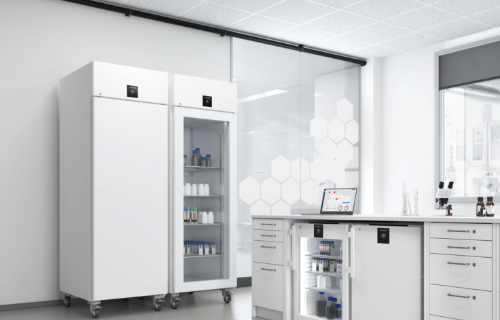
Laboratory refrigeration brings these two areas together. A refrigerator or freezer must maintain appropriate and consistent storage conditions, but its day-to-day performance also depends on how it is loaded, accessed and managed. Understanding these factors can help teams protect valuable materials while managing energy consumption and staff time.
At Liebherr, our research and appliance development explores what is happening inside laboratory refrigeration and how operational practices can be optimised. The question is straightforward; can laboratory cold storage work smarter without compromising what is inside?
Look beyond the set temperature
A refrigerator’s set temperature does not tell the whole story. Laboratory teams also need to understand how temperatures vary throughout the cabinet, what happens during routine access and how long conditions take to recover afterwards.
Research conducted by Green Light Laboratories at the University of Bristol, using Liebherr products, examined these questions through tests involving door openings, loading, inventory management and freezer settings.
The findings underline the importance of assessing temperature performance and energy consumption together. In the tests, the refrigerator that recovered fastest was not the one that used the least energy during recovery. Faster recovery did not automatically mean greater energy efficiency.
Laboratories therefore need to consider both measures; whether a refrigerator maintains suitable conditions for its contents and how much energy it needs to do so.
An organised inventory as an energy-saving tool
One of the clearest findings concerns something considerably less complex than refrigeration engineering: an appliance inventory.
In the Green Light study, researchers compared unorganised access with progressively more detailed inventories. A basic inventory identifying shelf ownership halved door-opening times and reduced the energy required for recovery by 57%. More detailed inventories reduced door-opening times by two-thirds and recovery energy by 62%.
These results highlight the practical value of knowing where materials are stored. Clearly labelled shelves, identifiable ownership and an up-to-date record of sample locations can support faster retrieval, reduce door-opening times and help teams manage cold storage more efficiently.
An inventory is therefore more than an administrative record. It can help connect everyday working practices with the performance of the appliance.
Capacity should mean usable storage
Alongside an effective inventory, understanding capacity requirements is an important consideration. Choosing refrigeration by its stated capacity alone can overlook a practical detail: not every part of the cabinet is necessarily available for storage.
Distinguishing between usable storage space and published net capacity helps laboratories assess whether an appliance can accommodate their storage requirements.
This should inform both purchasing decisions and everyday practice. Before adding another unit, teams should review what is being stored, whether existing inventories are current and accurate, and how much usable capacity remains within the manufacturer’s loading limits.
The aim is not to pack more into every available gap or overload an appliance. It is to understand how storage space can be organised and used effectively while maintaining the conditions its contents require.
Turn monitoring into action
Monitoring provides another opportunity to connect appliance performance with laboratory practice. Digital systems can record temperature histories, document alarms and notify responsible staff when defined limits are exceeded.
These capabilities are most useful when supported by clear procedures. Laboratory teams should establish who receives an alert, who responds outside normal working hours and what happens if the contents need to be moved.
Temperature records and settings should also be reviewed regularly. Any proposed adjustment to cooling operations should be assessed against the needs of the stored materials, relevant instructions and the laboratory’s quality procedures.
Monitoring is not simply about collecting data. It is about ensuring that the information supports informed decisions and an appropriate response when conditions change.
The first step to efficient cold storage
Improving cold storage starts with understanding how it is used. Reviewing one refrigerator or freezer, including its inventory, loading instructions, storage requirements, temperature records and alarm responsibilities, gives laboratory teams a manageable starting point for identifying practical improvements.
This is where equipment development and operational knowledge come together. Selecting an appropriate appliance matters, as does giving teams the information and processes they need to use it effectively.
Lab Innovations provides a valuable setting for sharing that knowledge and discussing the practical challenges laboratories face. Innovation can mean introducing new technology, refining established processes or combining the two. In laboratory refrigeration, it begins with understanding what happens behind the fridge door and giving the appliance the same scrutiny as the science it supports.
Mohammed Choudhury, Liebherr’s UK Research & Laboratory National Sales Manager, will explore these issues further during his session in the Live Lab on Wednesday 4th November from 11:00 am to 11:20 am. Visitors can also meet the Liebherr team on stand K70.