Skip to content



Artificial intelligence, laboratory automation and targeted funding are helping life-science organisations across the UK move promising research towards practical healthcare applications.
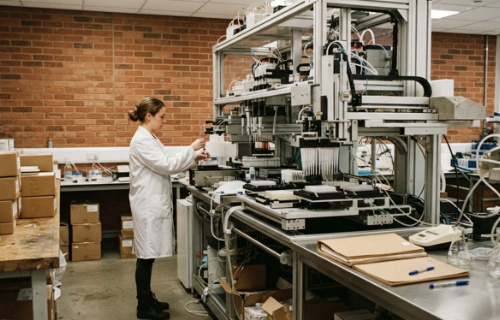
In the biopharmaceutical sector, AI is increasingly being connected directly to high-throughput biosensor workflows. These “lab-in-the-loop” approaches bring together automated experimentation and computational analysis, allowing scientists to use experimental results to inform the next stage of a research programme more quickly.
This can be particularly valuable in complex areas such as antibody and protein engineering, where researchers may need to assess a large number of potential candidates. Rather than replacing scientific judgement, AI-enabled systems can help teams prioritise experiments, identify patterns in large datasets and reduce time spent on repetitive manual processes.
The potential impact is shorter decision cycles in discovery research. When paired with reliable instruments, well-designed experimental workflows and robust data management, AI tools can help scientists focus on interpreting results and designing the most informative next experiments.
Alongside technology adoption, regional initiatives are providing practical support for organisations seeking to develop near-market life-science products. In the West Midlands, life-science firms have received government-backed funding intended to help accelerate the development of products and services with the potential for real-world use.
For early-stage businesses, access to funding can be as important as access to technology. Developing a laboratory concept into a validated product often requires equipment, specialist expertise, prototyping, quality processes and collaboration with clinical or industry partners. Targeted investment can help address these early barriers and support companies as they prepare to scale.
Daresbury Laboratory is also supporting health-tech and life-science innovators through incubator programmes that offer access to prototyping facilities, AI tools and business support. Shared innovation environments can be particularly valuable for smaller teams, enabling them to draw on specialist infrastructure and networks that may otherwise be difficult to access.
For laboratory professionals, these developments reflect a broader shift in how research is organised. Digital tools, automation and data-driven methods are becoming more closely embedded within experimental science, while innovation hubs are helping to connect research, commercial development and potential end users.
The opportunity is not simply to adopt AI or automation for its own sake. Successful implementation depends on clear research questions, high-quality data, validated workflows and scientists who can critically assess automated outputs. Equally, funding and incubator support are most effective when they help teams build the technical, regulatory and operational foundations needed for long-term progress.
Together, these initiatives demonstrate how connected laboratory technologies and regional support can help strengthen the UK’s life-science innovation pipeline.