Skip to content



Sustainability in LC-MS is most often discussed in terms of solvent consumption, and for good reason. Liquid chromatography relies heavily on mobile phases, frequently containing acetonitrile or methanol, which must be manufactured, transported, stored and eventually disposed of as chemical waste.
Reducing flow rates is one of the clearest ways to lower the environmental impact. Proteomics workflows require very high sensitivity to detect low-abundance biomarkers in complex biological samples, therefore the field has increasingly adopted microflow and nanoflow chromatography, approaches that cut solvent use by orders of magnitude compared with conventional flow rates.
Solvent is only part of the problem
However, lower solvent use does not mean a waste-free workflow. Proteomics laboratories still consume columns, require repeat analyses and, in many cases, use expensive instrument time inefficiently.
This is especially true in high-throughput proteomics. Large plasma studies compare samples from healthy individuals and patients in the search for novel or low-abundance biomarkers. Generating meaningful results often requires large cohorts, robust chromatography and hundreds or thousands of consistent LC-MS analyses. At that scale, small inefficiencies compound quickly.
Green chemistry therefore needs to extend beyond the mobile phase. It should also shape how products are designed, manufactured, monitored, used and recovered. Madrid-based Montara BioLabs is one example of a company taking this broader view across its nano-LC-MS technologies.
Less material, greater design flexibility
The environmental footprint of LC-MS begins with the hardware. Conventional manufacturing typically starts from a larger piece of material that is machined down to the required shape, producing offcuts and excess material, particularly for complex components made in relatively small volumes.
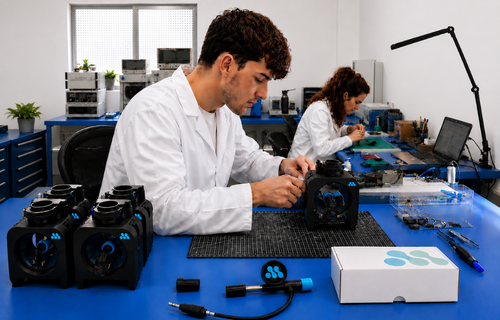
Additive manufacturing offers a different approach. Building components layer by layer reduces the amount of material required and allows several functions to be combined into a single, simpler part. Applied to 3D-printed ion sources, designed specifically for nanoflow proteomics, this reduces component count, simplifies assembly and adds geometric flexibility that conventional machining cannot easily achieve. It also opens the door to lighter, recyclable materials. Montara BioLab’s ion sources are around four times lighter than the current market standard, which lowers both material use and the energy required to ship them.
Just as important is where the parts are made. The conventional model concentrates production and distribution in a few global hubs, which are then redistributed onward to laboratories. Every unit therefore travels several long legs before it reaches the bench, and each leg adds cost and carbon.
Because additive manufacturing does not depend on large-scale tooling, production can instead sit close to the customer. Montara BioLab’s ion sources are built on demand in Madrid rather than mass-produced overseas and routed through a distribution hub, collapsing that multi-leg journey into a single shorter one. The result is a shorter supply chain, lower shipping costs and a smaller carbon footprint. Because parts are made only when they are ordered, there is also none of the overproduction and warehousing that the traditional model requires.
That flexibility also makes it possible to integrate more advanced functionality, such as a dual-emitter source that supports parallel column operation. While one column delivers a sample to the mass spectrometer, the second can be equilibrated and prepared, reducing the dead time between injections and making better use of valuable mass-spectrometer time.
Giving columns a second life
Chromatography columns are another significant source of laboratory waste. When performance declines, the entire column assembly, fittings included, is usually discarded.
A return-and-recycling programme offers an alternative. Under the Green Return programme, laboratories can return five used columns and receive one replacement free of charge, cutting waste while lowering the effective cost of ownership for high-consumption labs.
Packaging choices help too. Shipping columns in packs of two reduces the packaging and transport required per unit. Individually these are small adjustments, but their effect adds up across repeated shipments and large analytical campaigns.
When better data means less waste
Solvent and consumables are the visible forms of waste, however poor-quality data can be equally costly. An unstable spray, a gradually failing column or an unnoticed shift in system behaviour can compromise many samples before anyone notices. Those samples must then be reinjected, consuming additional solvent, instrument time and consumables. In some cases, a limited or irreplaceable biological sample is lost altogether.
Real-time quality control helps laboratories catch these changes sooner. The QuickFit Insights platform monitors LC-MS performance as a study runs, helping users judge whether high-quality data are still being acquired. Identifying a developing problem early prevents a long sequence of compromised runs, improves instrument utilisation and gives users greater confidence in the consistency of their data.
Sustainability and productivity are the same goal
As proteomics moves toward larger studies and higher throughput, sustainability and productivity should not be treated as competing priorities. In most cases, reducing waste also lowers cost, prevents repeat work and lets laboratories to do more with the resources they already have.
A greener LC-MS workflow is not simply the one that uses the least solvent. It is the one that extracts the greatest scientific value from every sample, column, component and hour of instrument time.
For more information, contact Montara Biolabs