Skip to content
The mass spectrometry (MS) data systems market reached USD $413M in 2023, with growth forecasted to reach USD $560M by 2028. (1) This expansion is driven primarily by the growth of the pharmaceutical and biopharmaceutical industries, public and environmental health concerns, growing government investment, and the integration of artificial intelligence (AI). (2)
The complex structures of advanced pharmaceutical products, such as biologics and biosimilars, are increasing the demand for advanced testing using MS technologies and its derivative analytical modalities, such as ion mobility, matrix-assisted laser desorption/ionization (MALDI) and MS imaging, to identify and quantify thousands of small molecules, metabolites and biomolecules with high accuracy and sensitivity. MS analysis provides the deep structural insights and critical quality attributes (CQAs) that improve drug candidate evaluation and shorten time-to-insight in the research and development (R&D) process for pharma and biopharma companies. (3)
Bringing candidate drugs to market quickly and cost-effectively, and pinpointing and eliminating failures from drug development pathways early helps reduce costs and maintain competitive edge. A typical research lab will have a range of analytical instruments with bespoke workflows, and the consequent fragmentation of vendor-specific data analysis tools prevents an enterprise from realising full value from the data generated.
Organisations are seeking to unify their instrumentation infrastructure into a cohesive analytical engine that accelerates drug discovery and development, reduces processing bottlenecks and better uses skilled scientific resources. Mass spectrometry produces some of the richest analytical data available, but much of that value is lost to fragmented, vendor-specific software.
Advances in the speed and sensitivity of MS instrumentation are generating vast amounts of data, and researchers are turning to specialist, multi-modal software platforms to manage a modern data workflow that unlocks deeper insights. The integration of AI is also gaining pace to improve efficiencies and automate outcomes for better informed decision-making. Built to be open-access and vendor neutral, mzmine by mzio processes data from any major instrument platform in a single software environment, from raw signal through to compound annotation. Across small molecule applications, including metabolomics and lipidomics, and environmental and drug discovery work, efficient data processing helps laboratories spend less time handling data and more time on the science.
Here, we examine some of the key considerations for pharma and biopharma companies looking to extract full value from the analytical laboratory and discusses how a company-wide data processing platform can add new value across the organisation.
Centralised data reduces margin for error
An enterprise-wide analytical foundation that integrates data from all major vendors and modalities allows departments to work within a unified platform with a consistent interface for all data. Ensuring that new workflows feel familiar reduces the cost and time required for training, and introducing a standard approach in the visualisation of results lowers the margin for error.
This centralisation of data repositories from all major vendors and unification of different file formats introduces new levels of enterprise-level collaboration across global laboratories and research groups. By bringing data together under one platform, pharma and biopharma organisations can establish enterprise-wide standard operating procedures (SOPs), reduce operational complexity, and maximise the reuse and amplification of scientific knowledge across the business.
Vendor-neutral advantages
Integrating all lab instruments and modalities in a vendor-agnostic platform removes the need for manual integration and inconsistent workflows, streamlining the analytical process to allow researchers to process tens of thousands of samples per day rather than hundreds. By consolidating workflows into a single interface, organisations will not only accelerate research timelines but also generate richer, more complete datasets that strengthen regulatory submissions and deepen scientific insight.
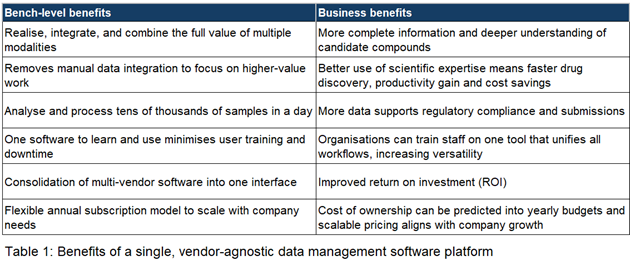
In terms of operations, this consolidation creates a long-term scalable system, removes the need for multi-vendor instrument licences, service agreements, information technology systems and user training programmes, and can significantly improve return on investment in capital equipment, as summarised in Table 1 below.
Removing barriers to innovation in study design
Breaking the software siloes and removing reliance on manual intervention in pharma and biopharma research and development supports larger and more complex study design. A sharp focus on productivity enables cutting-edge scientific methods to be quickly and securely integrated to stay ahead of development timelines.
A single, scalable platform that provides a complete view of the data landscape supports both productivity and creativity, allowing researchers to unlock the potential of bigger, more complex studies. With analytical labs subject to stringent regulations, software as a service (SAAS) platforms that store data in the cloud must comply with audit trail demonstration and validation.
As an alternative, platforms that implement high-performance processing entirely on-site enable a company to maintain control of their data security while benefiting from continuous deployment of new scientific advances into the software. The combination of scalability, security and innovation enables new, larger-scale study designs with greater clinical cohorts, more confident decision-making and stronger data packages for regulatory submission.
As data volumes increase and analytical complexity grows, pharma and biopharma companies rely on platforms that safeguard intellectual property, protect patient data and maintain regulatory compliance without limiting research productivity. A locally deployed software solution eliminates the risks associated with cloud-based transfers and external processing.
Fragmented to connected – a future-proofed solution
Pharma and biopharma organisations rely on predictable, reproducible and scalable workflows that can evolve with company growth, all while minimising operational risk and maintaining consistent performance across global sites. A modern solution for many businesses involves a flexible licencing model that supports organisational scaling, combined with expert guidance from an experienced support team that provides the foundation for smooth onboarding and rapid user confidence.
Research data is the key critical asset in pharma and biopharma organisations. As analytical complexity grows and the volume of data continues to increase, many companies are looking to implement a future-proof, compliant and vendor-neutral platform that maximises the value of this data across all scientific and operational teams. This approach transforms fragmented analytical workflows into an integrated, enterprise-wide engine for scientific research innovation and business value.
About the author
Dr. Ansgar Korf is a scientist and technology leader specialising in analytical chemistry, mass spectrometry, and scientific software development. Before mzio, he held senior positions at Bruker Daltonics, including Senior Manager Software Research & Development as well as global product manager for the timsTOF MS platform, combining scientific expertise with product strategy and cross-functional leadership. His academic background includes a PhD in Analytical Chemistry, with research focused on mass spectrometry data mining and computational methods for compound identification.
About mzio
Based in Bremen, Germany, mzio GmbH helps to unlock the full potential of MS by providing versatile and scalable software services that meet challenges faced by modern analytical labs. With more than 20 years’ experience in MS, analytical chemistry and software engineering, the team channels its expertise into software solutions helping to transform complex data into knowledge.
mzio solutions are used extensively across academia and industry, reflected by more than 7,000 citations in peer review journals and more than 20,000 active users. The unified platform for MS data processing elevates research, accelerates discovery and maximises a lab’s performance by unlocking the full potential of mass spectrometry. Contact mzio.
References
- Top-Down Analytics: Laboratory Data Management Software Market: LIMS, ELN/LES, SDMS, CDS & MS – Market Forecast 2023-2028, December 2023. Accessed 17 June 2026.
- MarkNtel Advisors: Global Mass Spectrometry Market Overview, Trends, Size and Forecast: 2025-2030, August 2025. Accessed 17 June 2026. https://www.marknteladvisors.com/research-library/mass-spectrometry-market.html
Markets & Markets: Mass spectrometry market, June 2026. Accessed 17 June 2026. https://www.marketsandmarkets.com/Market-Reports/mass-spectrometry-market-437.html