Skip to content



By Laurence Dawkins-Hall BSc., CSci, CBiol, FIScT, FRSB.
Prologue
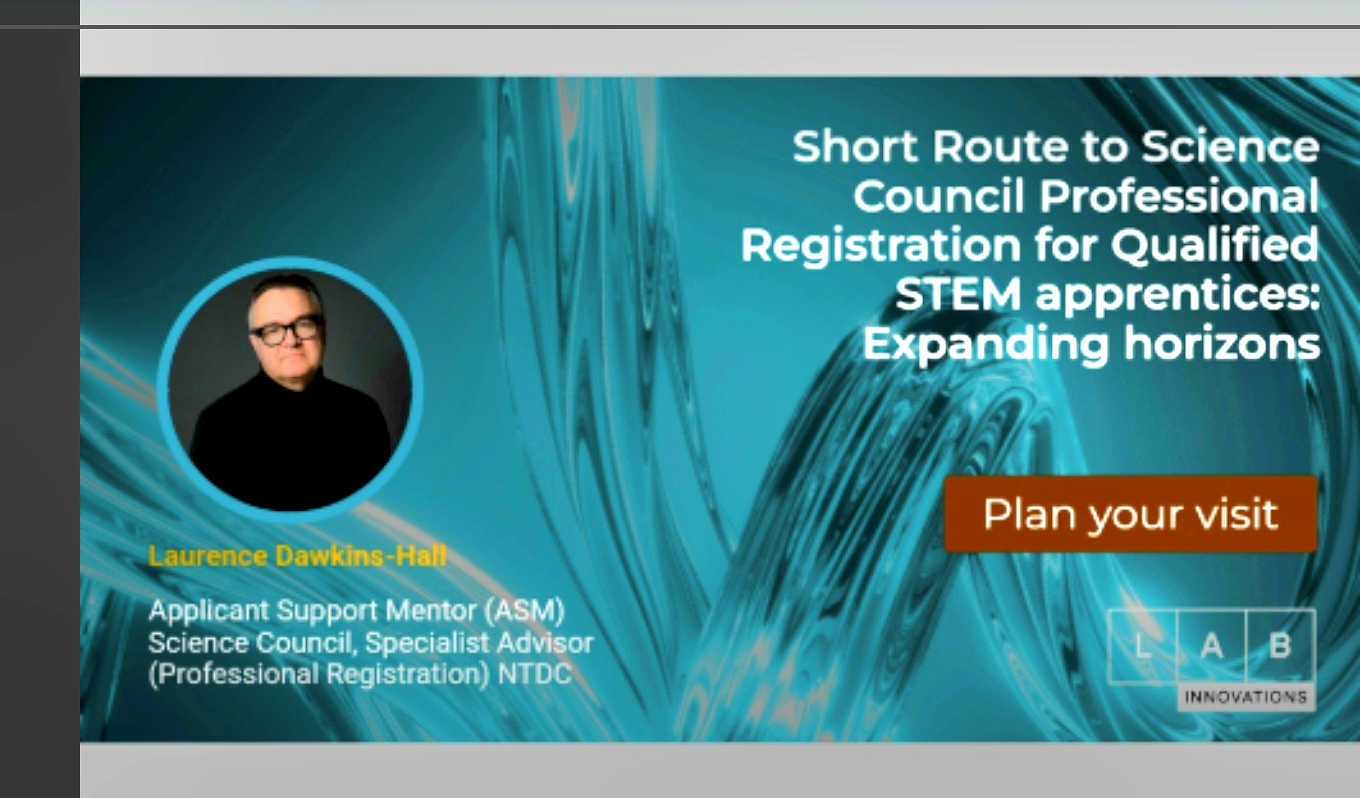
In 2025, I provided a talk at Lab Innovations on an expedited scheme for qualified STEM apprentices, who are contemplating applying for Science Council Professional Registration.
The Talk was integral to the Quality Infra structure forum, as it described a vocational standard applicable to STEM scientists.
In the following piece, I describe another vocational standard, Chartered Biologist, denoted by the post nominals “CBiol”. The article articulates:
- What a Chartered Biologist is.
- The benefits of becoming a chartered Biologist.
- Who is eligible to apply?
- How to apply.
- Obtaining and retaining your post nominals.
- An introduction to my online on demand Chartered Biologist course, designed via webinars to discuss all aspects therein in detail.
Introduction
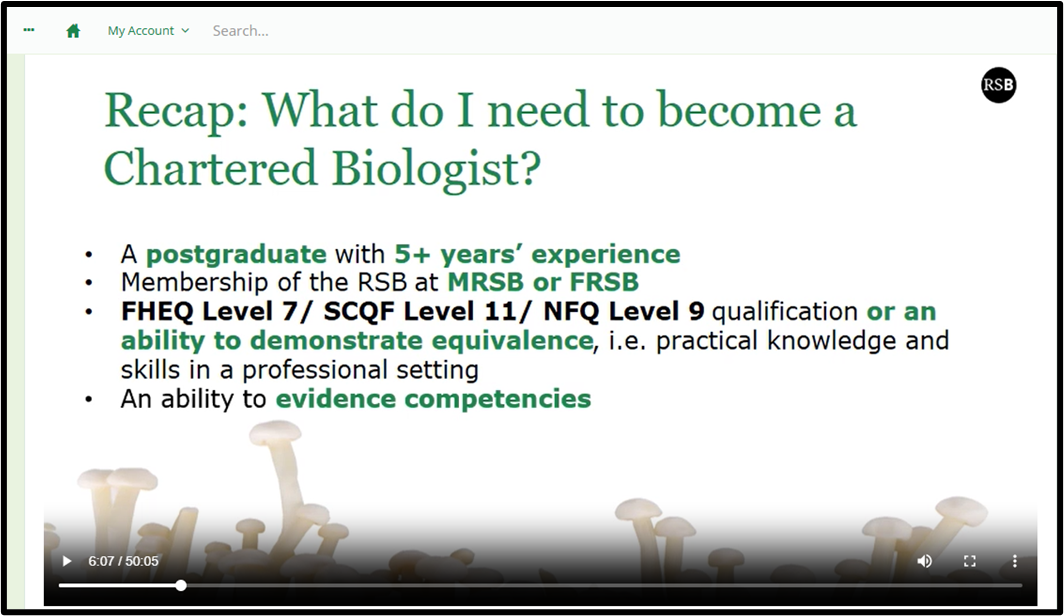
The award of Chartered Biologist is provided to dedicated Life science Professionals who hold membership with the Royal Society of Biology (RSB) and in addition possesses either an RQF Level #7 qualification (e.g., a Specialist STEM M.Sc. or M.Res. qualification) with an additional 3-5 Years of dedicated post graduate specialist working practice in a Professional life science setting or, alternatively, 5-10 years of demonstrable post graduate experience without a level #7 qualification. The exact length of experience mandated will depend upon the qualifications you hold, ranging from a level #6 Bachelors (B.Sc.) in life sciences, plus 6 years of specialist graduate experience in a Professional setting to between 8- and 10-years’ experience, consonant with Level #7 practice and either A levels in STEM subjects or GCSE passes in STEM subjects. The latter provision is designed to make the award of Chartered Biologist inclusive, so that school leavers who have entered a life sciences environment and worked their way up the career ladder are not precluded.
A stipulation of CBiol is becoming a full member of the RSB (MRSB) and the time taken to attain this will vary, depending on your starting point. As a general rule, the “pro forma” is MRSB plus 3 years specialist life sciences experience, with implied duration of initial experience, designed to attain MRSB, dependent on starting qualifications and/or incumbent job responsibilities. Having attained MRSB the route to Charter is then standard, i.e., a further three years of post-graduate experience at RQF level #7 in a professional life science setting. Many such settings are wholly or partly laboratory based.
What are the benefits to becoming Chartered?
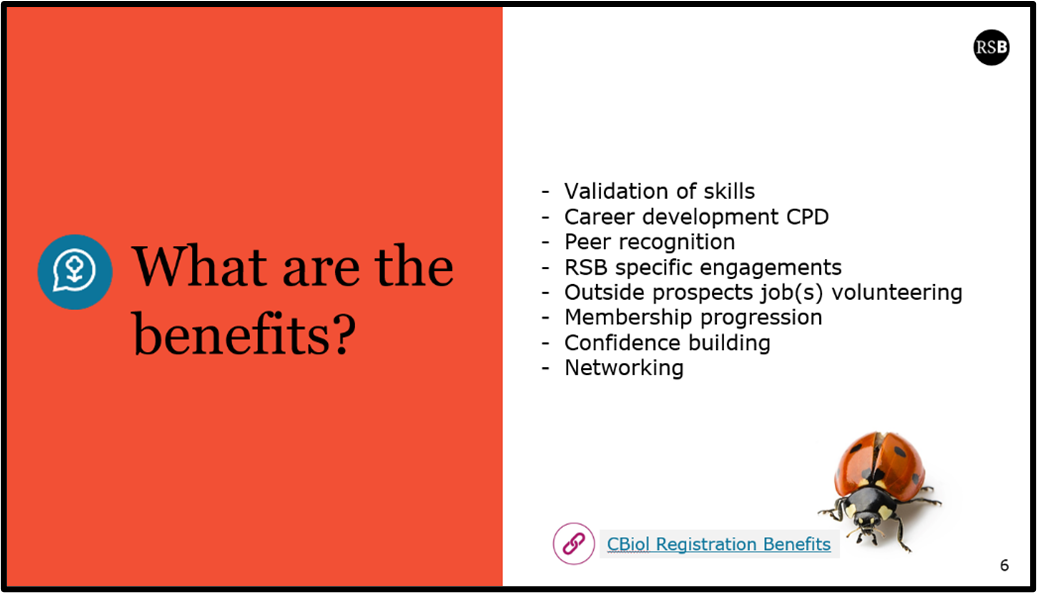
Becoming a Chartered Biologist mirrors and augments the benefits of full membership (MRSB). Seminal benefits of both are listed above. So why take the extra step from MRSB to become Chartered as well? I would conjecture there is synergy between the two: In other words, opportunities afforded by full membership of the RSB, e.g., participation in committees; running bespoke training sessions; accessing and perhaps writing for RSB specific journals are useful evidential materials for CBiol competency answers but, having attained your “CBiol” on top of your “MRSB” post nominals, the former increase these opportunities over and above MRSB per se.
As a reminder, these are:
- Validation of Skills: CBiol nomination accredits all types of skills via competency working practices, not just technical proficiency. As such it is a vocational award, not an academic qualification.
- Confidence building: The work that goes into putting in a successful application, culminating in post nominals, invariably boosts confidence.
- Career development and CPD: By virtue of possessing RSB, cf. MRSB and especially as a chartered biologist, there are ample opportunities to engage in RSB specific activities, including policy influence via select RSB committees and, training courses and access to publications and, moreover, opportunities to publish; or indeed create on line courses like the one discussed below! Furthermore, the RSB is now offering specific institutes the chance to provide “Employer Accreditation” for the award of Chartered Biologist, which could have implications for in house career development/CPD.
- Peer Recognition: Those post nominals make you “stand out from the crowd”.
- RSB Specific Engagements.
- Outside job prospects: Many jobsnow have an application section, asking you to detail professional awards.
- Networking: As a member of the RSB, you can network with likeminded life scientists.
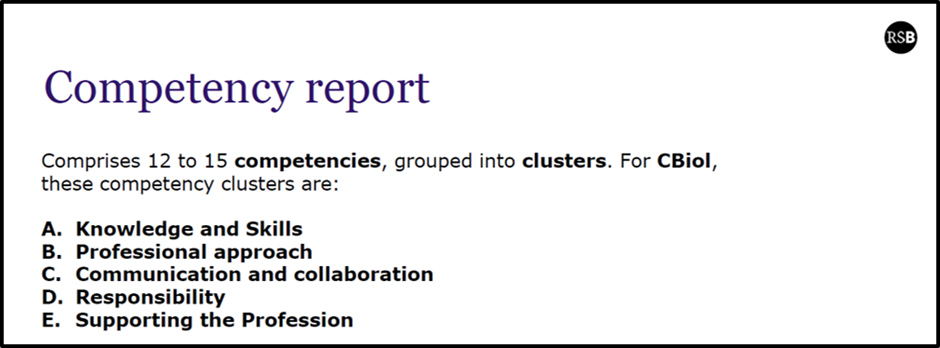
As shown below, this constitutes useful CPD and consequently, there is a “virtuous circle” between MRSB, CBiol and CPD; Specifically:
- Becoming MRSB (by virtue of say lab practice).
- Taking advantage of the benefits that brings, e.g., participation in RSB activities.
- Three years hence becoming chartered.
- Taking advantage of additional benefits that affords, e.g., in my case mentoring and assessing for the RSB for the chartered award and, moreover, designing and recording an on-line learning aide as well.
- Codifying these opportunities into CPD and in doing so, remaining on the RSB Chartered register.
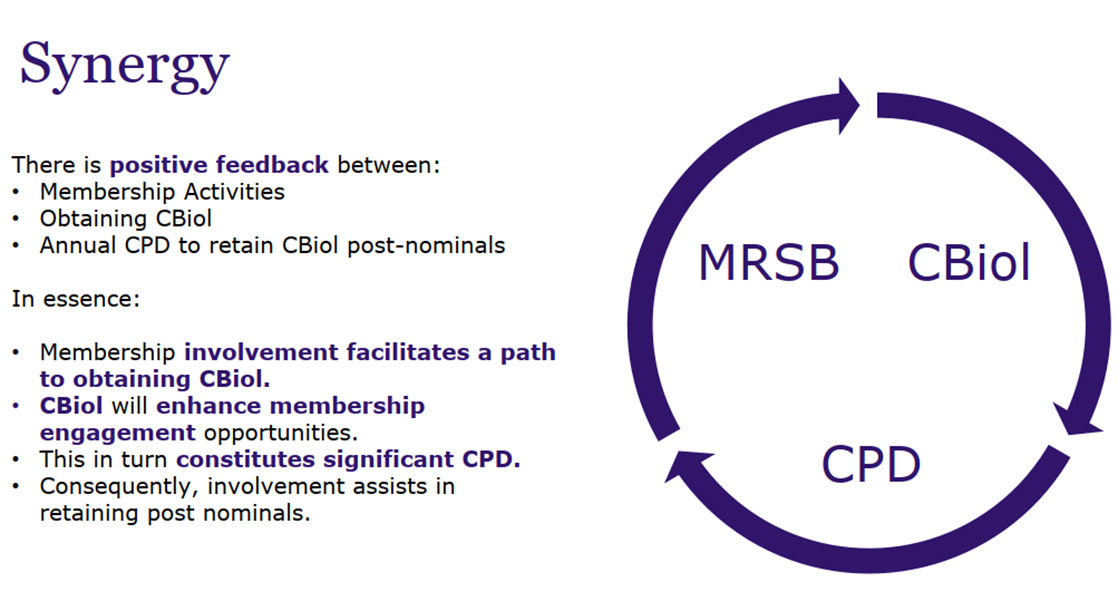
So, what skills do competencies Evaluate?
Competency answers are themed and mandate evidence of competent practice, from the last 3-5 years, regarding empirical theory and practice (Section A); planning, organisation, and efficient use of resources (Section B); Proficient practice in terms of communicating within and/or supervising specialist teams, as well as demonstrable interaction with non-specialists, like finance, outside companies and where applicable non specialist stakeholders (Section C); Demonstrable practice in terms of ethics, compliance with existing and new rules and due regard for sustainable practice (Section D) and finally evidence regarding support of more junior colleagues within and outside of the work place in bioscience settings, the latter including voluntary settings outside of paid STEM employment (Section E).
In conclusion the vocational award of Chartered Biologist is designed to accredit ethical, technical and competent specialist practice in a plethora of life sciences fields, including different Laboratory specialisms. As such, competency descriptors are indubitably generic and the inclusion of too much technical jargon without qualifying explanations is contra-indicated.
The achievement of CBiol and resulting postnominals is a conspicuous mark of excellence and, as such, makes you “stand out from the crowd” and is known to provide traction is terms of job interviews, career progression and outside prospects impacting CPD, as already described.
An Online CBiol course guide
The online, on demand Chartered Biologist course has been written and presented by me as a compliment to a pre-existing “guideline for applicants”.
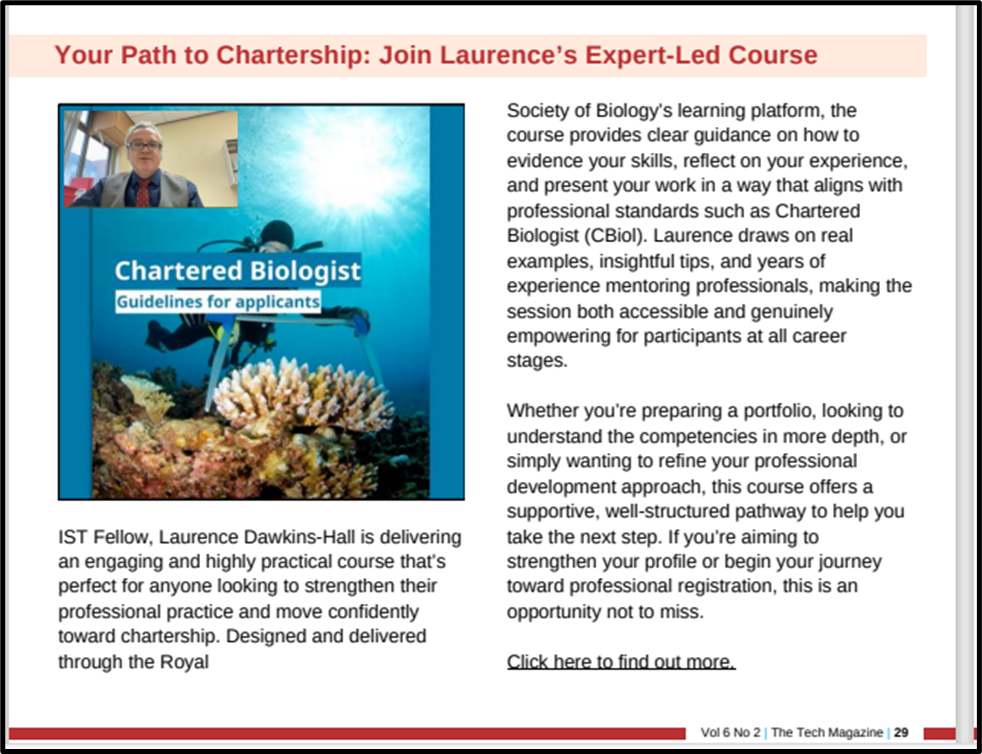
The guide and the actual online course both give examples of scenarios that might be adapted or contextualised in terms of personal evidential practice.
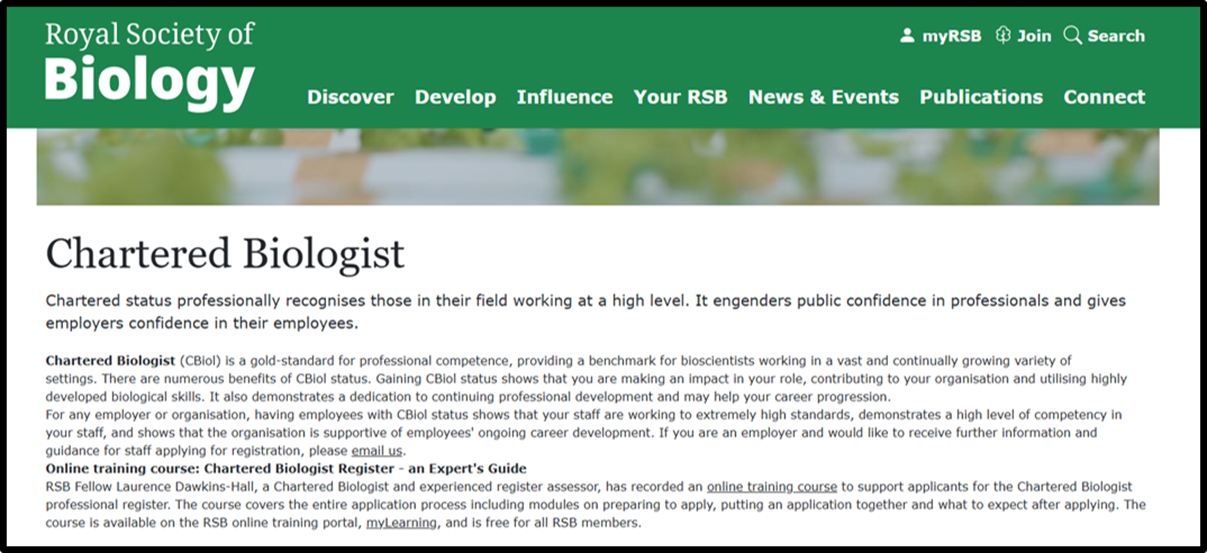
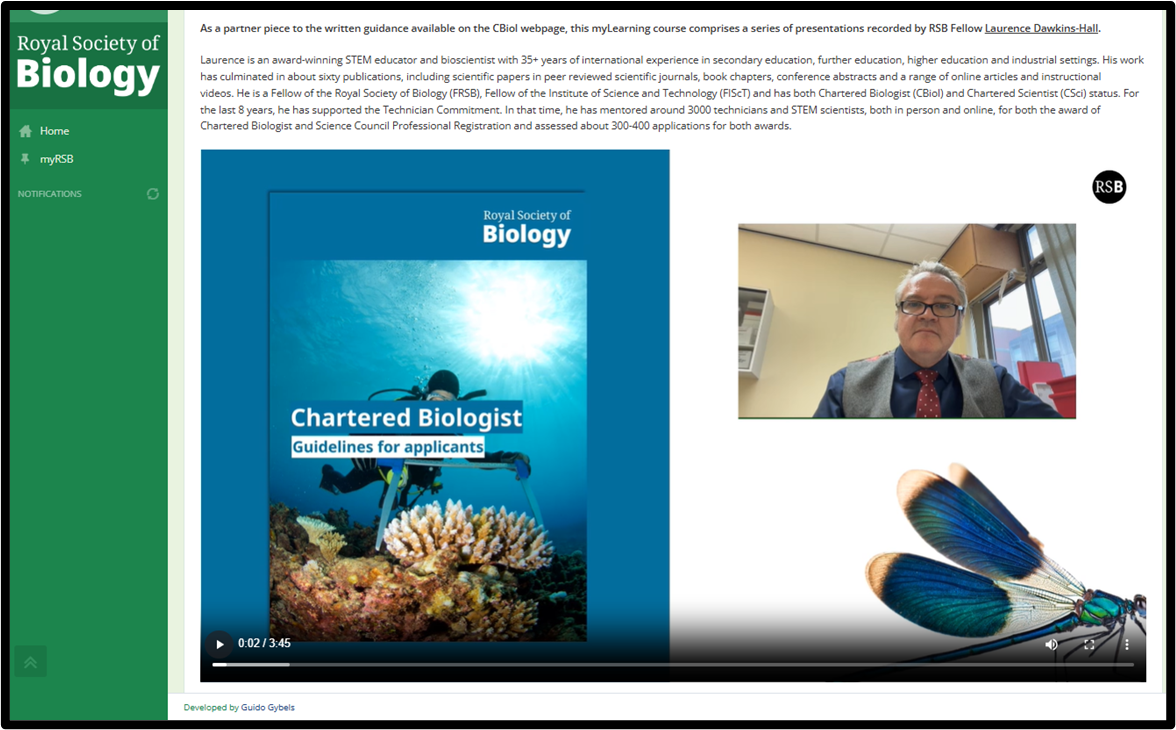
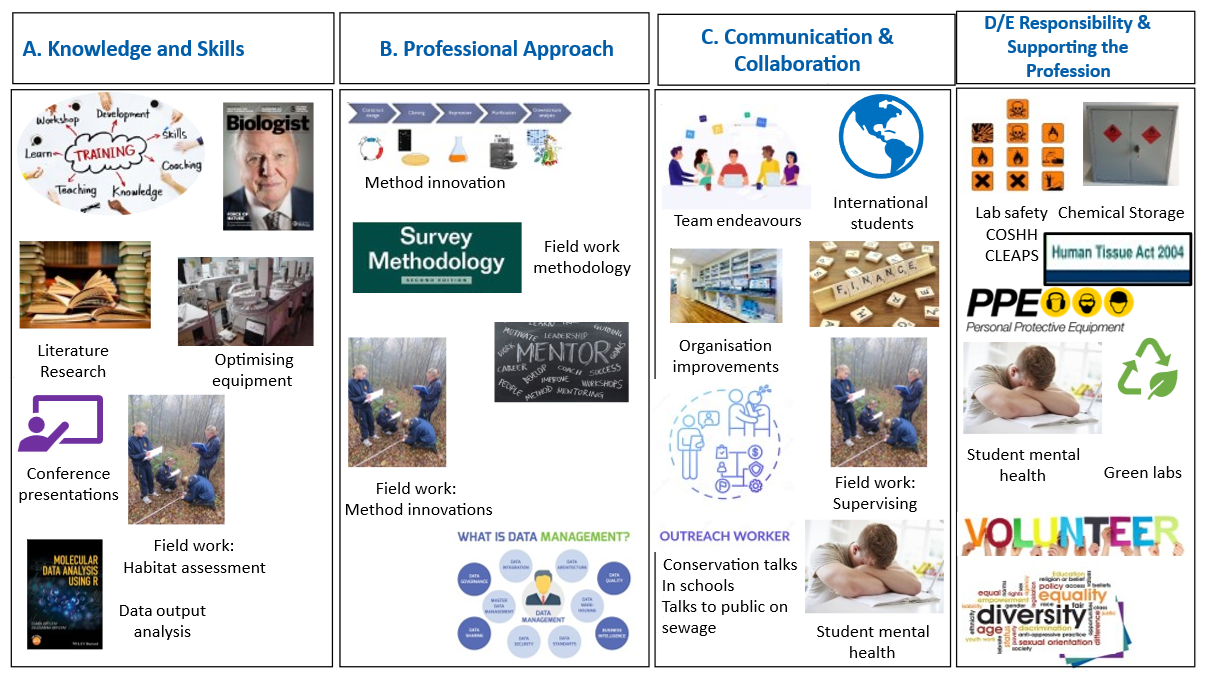
In addition, the online course also provides recorded verbal commentary. Moreover, the course enables transcripts of webinar commentary to be visualised and saved and, similarly, the slides associated with each module can be archived. Finally, the course can be completed in your own time, by dipping into and out of modules, with progress tracked and completion monitored.
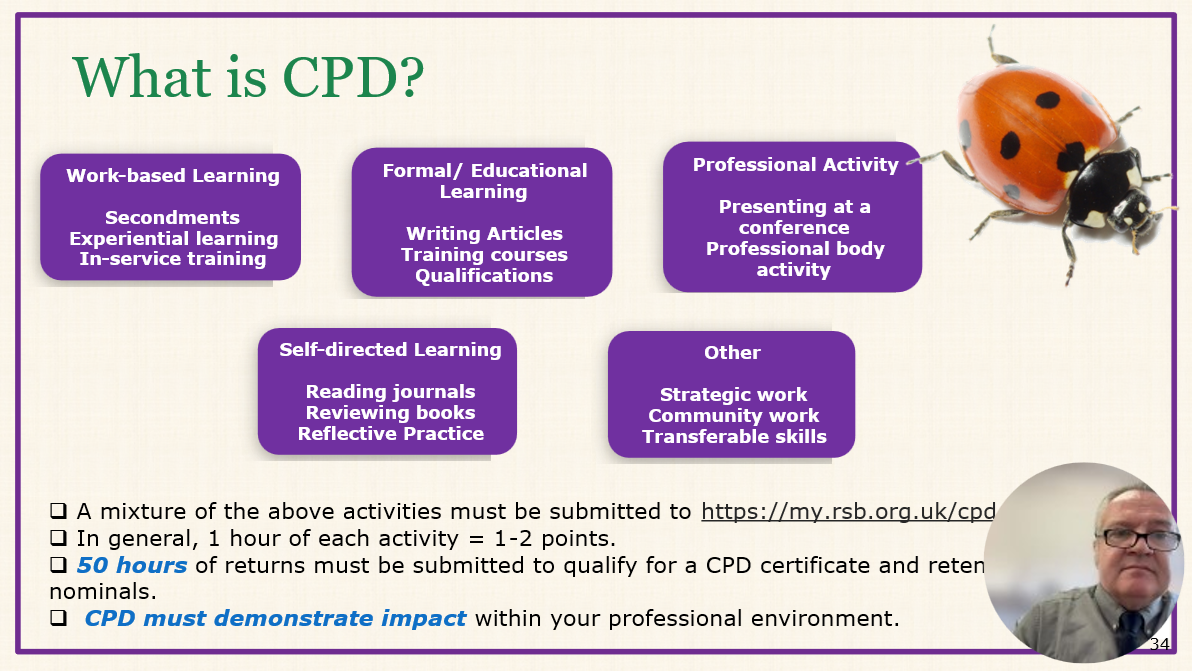
Renewing your Charter: Annual CPD
Every year, it is necessary to submit a CPD report to the RSB to prove practice consonant with the initial application, in order to remain on the RSB Chartered Register.
Annual CPD submissions to the RSB via “my RSB”can be logged through the “Continuous Professional Development” menu, and are grouped into five principal themes:
- Experiential learning.
- Training courses.
- Professional activity, e.g., presenting at a conference.
- Reflective practice.
- Transferable skills.
To retain your (CBiol) post nominals and remain on the RSB Chartered Register, you need to include exemplars of derived practice from three or more of the above categories. There should be no less than fifty hours of resulting CPD.
Acknowledgement
Putting together my Chartered Biologist course was a labour of love and required reflection, re wording, re-recording and tenacious application to generate the individual webinars that make up the course. I further defined and refined my thoughts and explanations by discussions with my friend and mentor, Mr Christopher Rawnsley. Accordingly, I would like to dedicate this article and my ensuing efforts to capture the process of chartership in my on-line course to him.
Chris Rawnsley